
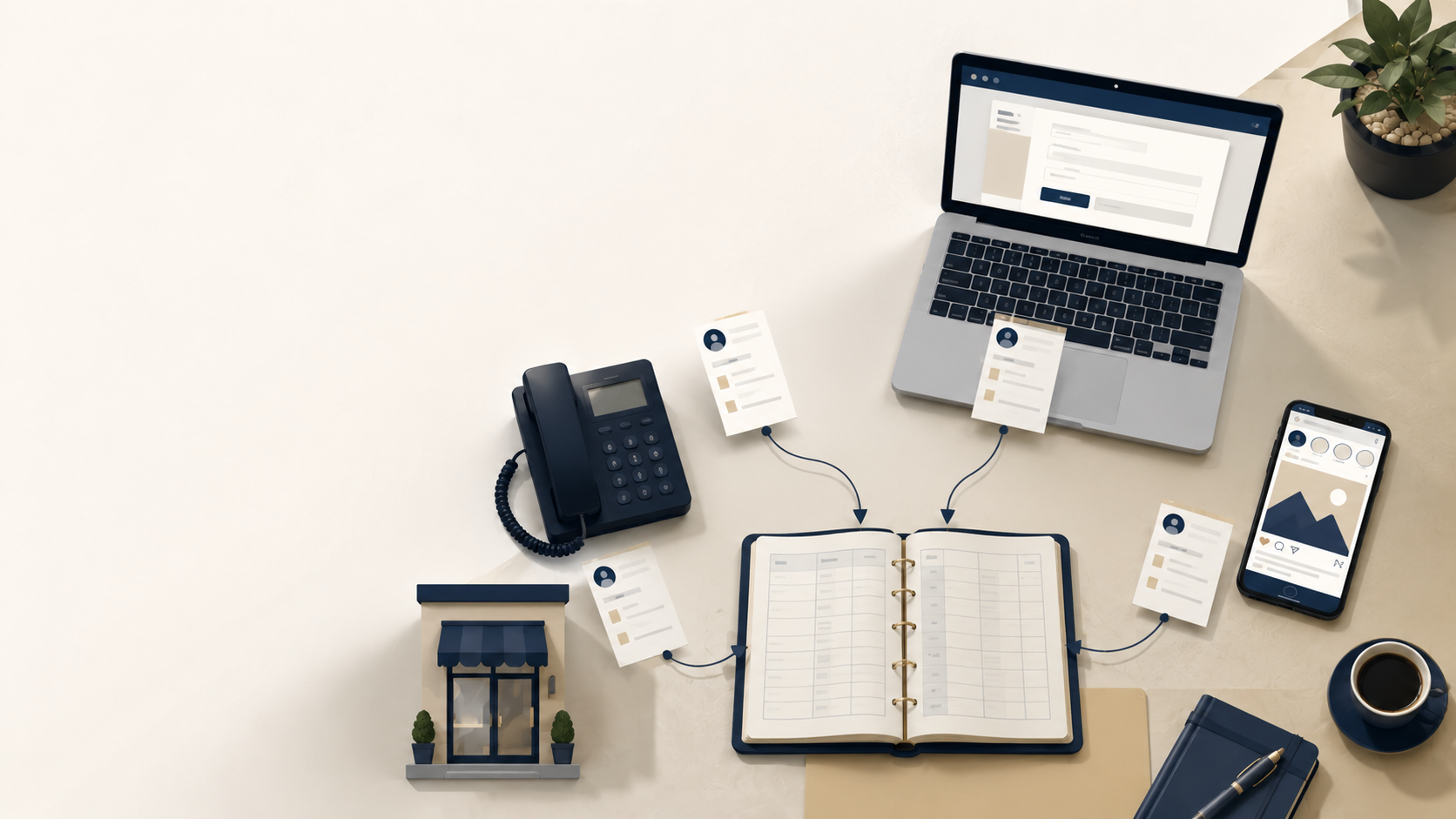
Take one business, one week, and no enquiry management system for small business operations in place. A form submission on the website lands in the marketing inbox. A phone enquiry gets logged only if the person who picks up remembers to write it down. A message on the social page sits inside that page’s own inbox until someone opens it. A walk-in gets a name on a paper register that never leaves the reception desk. Four channels, four owners, four places where the same kind of information starts and then stops, and by the end of that week no single document holds all of it.
Ask the business how many enquiries came in last month and the answer is a guess. Ask which channel actually produces admissions or sales, as opposed to which channel produces the most messages, and the answer is a stronger guess. Ask how long it takes, on average, for someone to respond to a new enquiry, and there is usually no answer at all, because no one has ever timed it.
The enquiries are happening. The record of them is split across four systems that do not talk to each other, owned by four different people, none of whom has visibility into what the other three are holding. A marketing team celebrating a strong month of form fills has no idea whether the phone team is converting those leads or letting them sit uncontacted for a week. A front-desk register full of walk-in names never makes it into any system the sales team can search.
Enquiry volume is rarely the issue; most businesses already generate enough of it. Nothing counts those enquiries in one place, so nothing about the process can be measured, compared, or improved. This is the operational layer that gets skipped in favour of running another campaign, because a log is boring and a campaign has a launch date.
What an Enquiry Management System for Small Business Needs to Hold
What a business actually needs here is an enquiry management system for small business operations: one automated log that every channel feeds into, regardless of where the enquiry originated, built out of tools already in use rather than a new CRM or an added headcount. Victory TechNxt refers to this layer as an AI-Powered Digital Office: forms, calls, social inboxes, and walk-in entries written into one system instead of four. For a business running four channels at once, lead management for MSMEs has usually meant a paper register in one hand and a WhatsApp thread in the other, with nothing forcing the two to reconcile.
A website form submission writes a row. A call, once logged by whoever answers, writes a row. A social media DM, pulled through automation instead of manual copy-paste, writes a row. A walk-in, entered by the front desk on a phone or tablet instead of a paper register, writes a row.
Each row needs to carry:
- Name and contact number
- Source channel (website, call, social, walk-in)
- Date and time the enquiry came in
- Who owns the follow-up
- Current status (open, contacted, converted, dropped)
- Date the status last changed
None of the four channels need new software to make this work. What changes is that each one writes to the same place, through small pieces of automation that remove the need for anyone to remember to do it manually.
What becomes countable
For a small business in India, lead tracking usually stops at “the enquiry came in” and rarely extends to what happened next.Once an enquiry management system for small business operations is actually in place, three things become measurable for the first time.
Response time. The gap between when an enquiry arrives and when someone first makes contact. This number alone usually explains more about conversion than the marketing spend does. A widely cited Harvard Business Review study on sales leads found that firms contacting a new enquiry within the first hour were far more likely to qualify it than firms that waited a day or more, and a large share of companies studied never responded at all
Source. Which channel produces the enquiries that actually convert, as distinct from which channel simply generates the highest volume of them. These are rarely the same channel, and a business that has never measured this is allocating its follow-up effort and its ad spend on a guess.
Drop-offs. The point in the pipeline where enquiries stop moving. An enquiry that sits at “open” for two weeks is a data point, not yet a lost sale, telling the business exactly where the process is breaking, if anyone is counting.
None of this requires more enquiries, only an enquiry management system for small business operations that already holds the ones arriving.
Victory TechNxt’s Growth & Authority Audit looks at exactly this for a business’s own enquiry process: where the four channels currently land, what’s already being tracked, and what a working log would take to build.
Request the audit.