
You’ve probably seen it happen.
A customer asks a chatbot a question. The chatbot gives an answer that doesn’t quite make sense. The customer asks again. Another generic response appears.
After a couple of attempts, the customer gives up.
That experience can leave a bad impression, especially when the person came to your website because they were already interested in your business.
A useful chatbot needs to know when it can answer a question and when it should step aside. No matter how well-built an AI chatbot for business is, there will always be questions it hasn’t been prepared for.
That is where human handover in AI chatbot conversations becomes important.
Your Chatbot Doesn’t Need to Know Everything
No matter how much information you give your chatbot, there will always be questions it hasn’t been prepared for.
A customer might ask about a very specific situation.
They might want a custom quotation.
They might have a technical issue that needs someone from your team.
Or they may simply type:
“Can I speak to someone?”
The right response isn’t to keep the customer trapped in the chatbot.
The chatbot should recognise that the conversation needs a person.
What Is Human Handover in AI Chatbot Conversations?
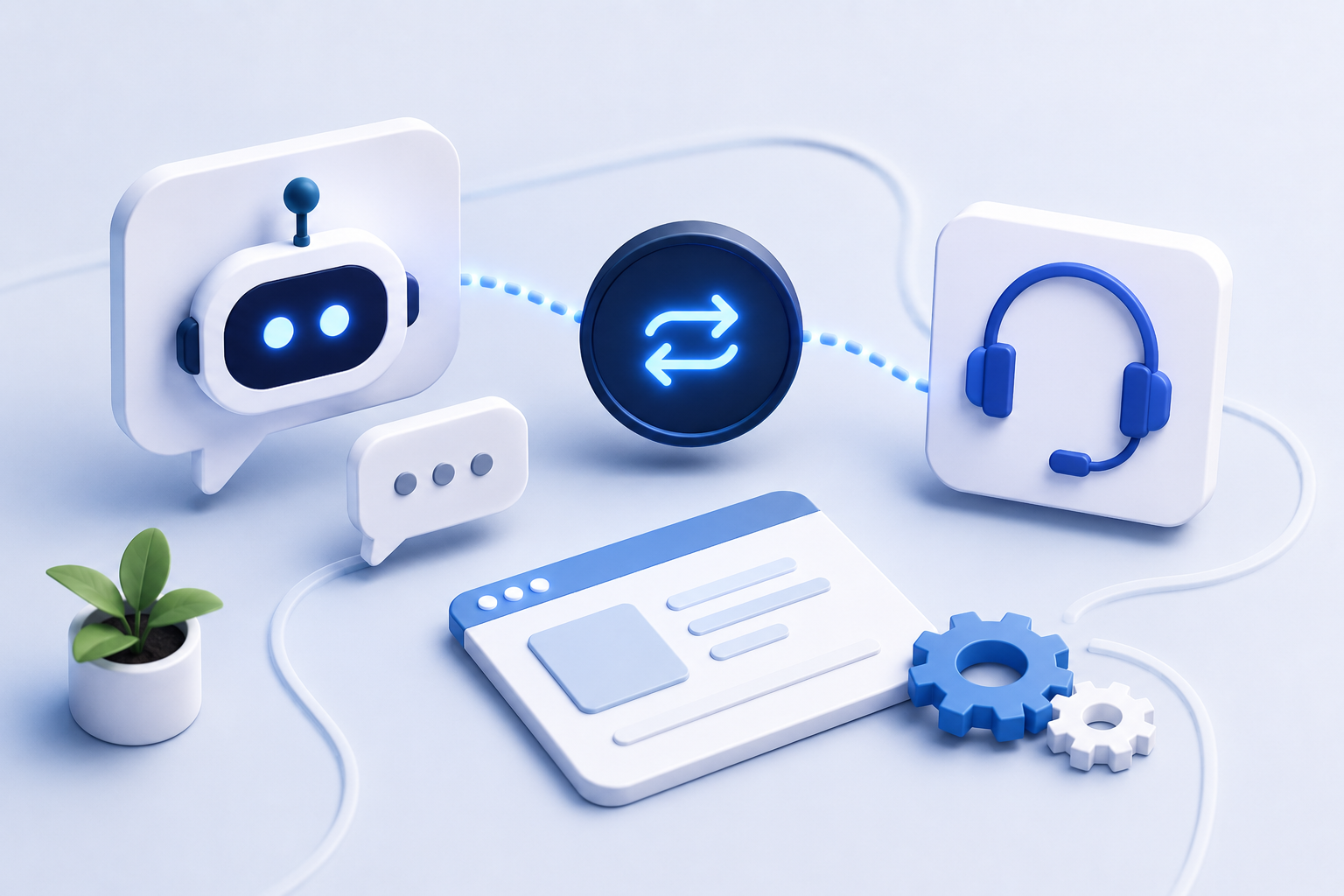
Human handover is the point where a chatbot passes a conversation to a real person.
The chatbot handles the initial interaction and answers what it can. When the conversation requires human help, the team takes over.
It sounds simple, but it changes the way a website conversation works.
Instead of:
Customer → Chatbot → Dead end
the journey becomes:
Customer → Chatbot → Human team
The customer gets help without having to start the entire conversation again.
Why Does Human Handover Matter?
Imagine a visitor has spent five minutes explaining what they need to a chatbot.
The chatbot reaches a question it cannot answer.
If the visitor now has to open an email, fill out a form, or explain everything again to a support executive, the experience becomes frustrating Zendesk’s 2026 CX Trends data found most consumers are bothered by having to repeat themselves to different agents.
A proper handover keeps the conversation moving.
Your team can see what the visitor has already asked and continue from there.
That small difference can make the interaction feel much more natural.
The Chatbot Should Know When to Stop
One of the biggest mistakes businesses can make with AI chatbots is expecting the chatbot to answer every question.
That’s when you start seeing made-up answers, irrelevant responses, or conversations that go around in circles.
A better approach is to give the chatbot clear boundaries.
If the answer exists in the business knowledge, the chatbot can provide it.
If the information isn’t available or the conversation needs human attention, the chatbot should give the visitor a clear next step.
ChatAI CRM is built around this approach. It uses the business’s own knowledge for visitor questions and provides a route for conversations to be handed over to a person through the inbox when human help is needed.
This is exactly where human handover in AI chatbot design becomes essential.
What Does a Human Handover Look Like?
Let’s take a simple example.
A visitor comes to a software company’s website and asks:
Visitor: “Do you have a plan for a team of 50 users?”
The chatbot can answer based on the information available to it.
The visitor then asks:
Visitor: “We have some specific requirements. Can someone from your team discuss this with me?”
That’s a good point for a human to step in.
The chatbot can guide the visitor toward connecting with the team.
The team then receives the conversation with the context already available.
The customer doesn’t have to repeat:
“I was talking to your chatbot about the 50-user plan…”
That context is already there.
Human Handover Can Help Your Sales Team Too
Human handover isn’t only useful for customer support.
It can be valuable during sales conversations.
A visitor may start by asking about a product.
Then they ask about pricing.
Then they explain what their company needs.
At that point, the conversation may be ready for someone from sales.
The sales representative already knows what the visitor was interested in and why they wanted to speak with someone.
That gives the salesperson a better starting point for the conversation.
That’s the kind of connected experience good human handover in AI chatbot workflows are meant to deliver.
What If the Visitor Asks Something the Chatbot Doesn’t Know?
This is where your chatbot’s knowledge matters.
A business chatbot should be working from information provided by the business, such as:
- Products
- Services
- FAQs
- Policies
- Locations
- Other information customers regularly ask about
If something isn’t covered, the chatbot should have a way to handle that situation.
ChatAI CRM’s knowledge workflow focuses on keeping the assistant within the information provided by the business and identifying questions that it cannot answer.
Those unanswered questions can also tell your team where more information needs to be added.
An Unanswered Question Can Actually Be Useful
Suppose five visitors ask the same question and the chatbot can’t answer it.
That tells you something.
Maybe the information is missing from your knowledge base.
Maybe your website doesn’t explain the service clearly.
Maybe customers are looking for information you didn’t realise was important.
Instead of seeing an unanswered question as a failure, your team can use it as feedback.
Add the missing information.
Improve the relevant page.
Update the chatbot’s knowledge.
Then the next visitor may get the answer immediately.
Human Handover Should Feel Like Part of the Conversation
The worst handovers feel like starting over.
A customer explains their problem to the chatbot.
Then they are told to email support.
They send an email and explain the same problem again.
Then someone calls them and asks for the details again.
That’s a lot of repetition.
A better experience keeps the conversation connected.
The chatbot handles the initial questions.
The customer asks for human help.
The team picks up the existing conversation.
The customer continues from where they left off.
That’s the kind of workflow ChatAI CRM is designed to support through its chatbot and inbox.
Does Human Handover Mean You Need Someone Watching the Chat All Day?
No.
The whole point of using a chatbot is to let it handle the conversations it can manage.
Your team can step in when a conversation actually needs them.
That could be a complex question, a sales opportunity, a support issue, or a visitor who specifically wants to speak with a person.
The chatbot takes care of the first layer.
Your team takes care of the conversations that need human attention.
How ChatAI CRM Handles the Journey
ChatAI CRM brings these pieces together around the website conversation. ChatAI CRM brings human handover in AI chatbot conversations together in one connected workflow
First, the chatbot answers questions.
It uses your business knowledge to respond to visitors.
Then, it captures the enquiry.
When a visitor shares their details, the lead stays connected to the conversation that created it.
Finally, your team can step in.
When human help is needed, the conversation can be handed over through the inbox.
The idea is straightforward.
Let the chatbot handle what it knows. Give the team the conversations that need a person.
What Should You Look for in an AI Chatbot?
If you’re considering human handover in AI chatbot support for your website, ask a few practical questions:
Can it answer using your actual business information?
What happens when it doesn’t know something?
Can a visitor ask to speak with a person?
Does the team have a shared place to pick up conversations?
Can the team see what the visitor discussed with the chatbot?
Can unanswered questions be reviewed later?
These details matter just as much as the chatbot’s ability to answer questions.
Because a chatbot isn’t useful only when everything goes according to plan.
It’s also useful when something unexpected happens.
Final Thoughts
A good AI chatbot knows what it can handle.
A good customer experience also knows when a person needs to take over.
Human handover gives businesses a way to combine both.
The chatbot can handle routine questions and keep conversations moving. When a visitor needs something more specific, the conversation can reach the team without forcing the customer to start again.
That’s the approach behind ChatAI CRM.
Answer the question when the chatbot can. Bring in your team when a human is needed. Keep the conversation connected.
Frequently Asked Questions
1. What is human handover in an AI chatbot?
Human handover is when an AI chatbot transfers a conversation to a real person because the visitor needs assistance that the chatbot cannot provide.
2. When should an AI chatbot hand over a conversation?
A handover can happen when the chatbot cannot confidently answer a question, when the visitor needs a complex response, or when the visitor specifically asks to speak with someone from the team.
3. Does ChatAI CRM support human handover?
Yes. Human handover in AI chatbot conversations is fully supported by ChatAI CRM, which provides a route for conversations to be handed over to a person through the inbox whenever human help is needed.
4. Will the customer have to repeat their conversation after handover?
The purpose of keeping the conversation connected is to give the team the context they need to continue the interaction rather than making the visitor explain everything again.
5. What happens when the chatbot doesn't know an answer?
The chatbot should avoid making up information. The conversation can be routed toward human assistance, while the unanswered question can also highlight a gap in the business knowledge available to the assistant.
6. Can human handover help sales teams?
Yes. A sales representative can take over when a visitor moves from general questions to a conversation about specific requirements, pricing, a quotation, or another sales-related request.
7. Can businesses learn from conversations that require human help?
Yes. Unanswered questions and knowledge gaps can show businesses which topics visitors are asking about and where the chatbot needs additional information.
8. Does human handover defeat the purpose of using an AI chatbot?
No. The chatbot can still handle routine conversations while human agents focus on situations that require judgment, detailed assistance, or a personal response.