
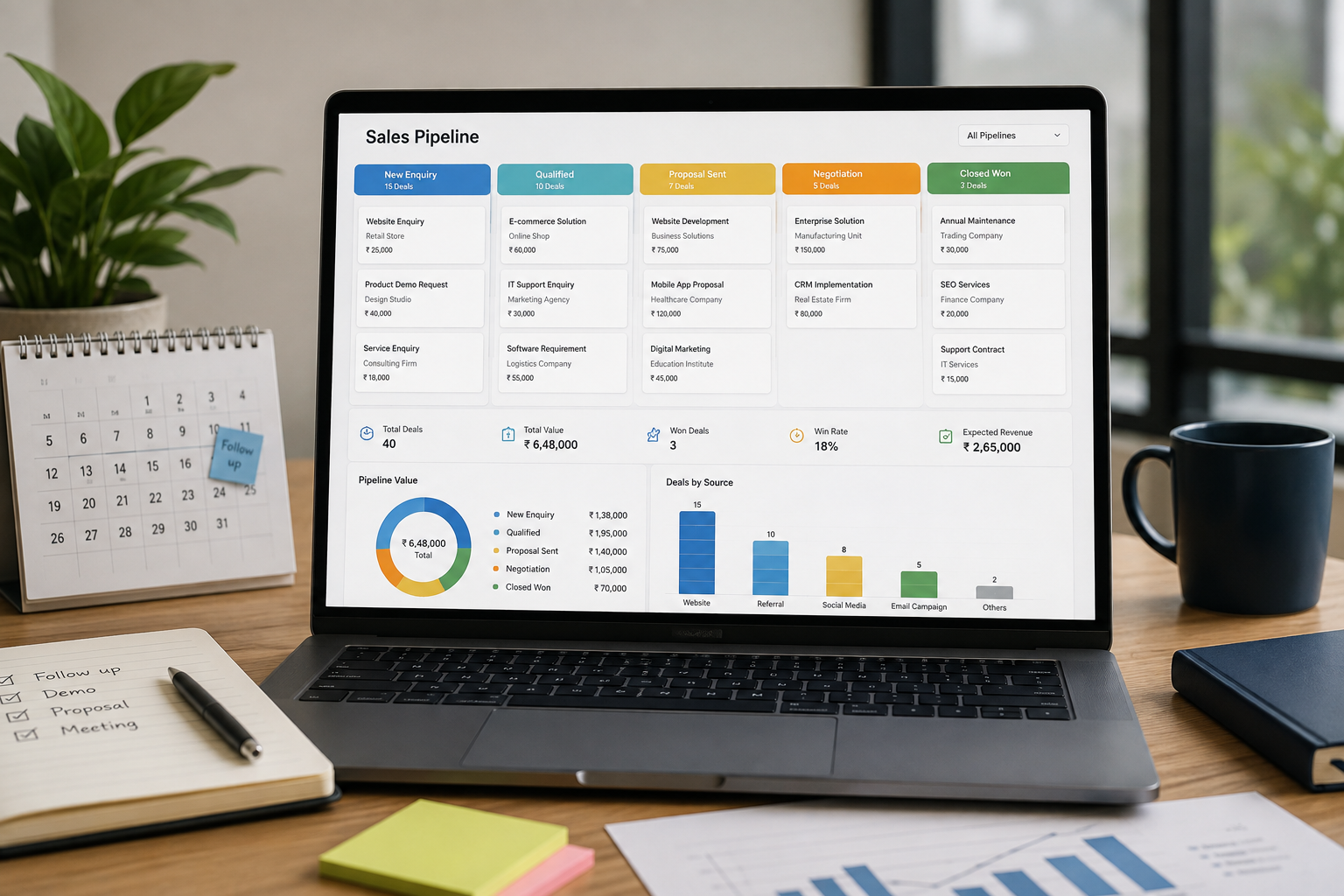
Sales Pipeline Management is what separates chaotic follow-ups from consistent, closed deals for growing businesses. Without a structured sales pipeline, many businesses struggle to keep track of where each customer stands.
Opportunities are forgotten, follow-ups are delayed, and sales forecasts become guesswork. A sales pipeline gives your team a clear picture of every deal from the first enquiry to the final conversion.
1. Every Opportunity Looks the Same
Many businesses keep customer information in spreadsheets, notebooks, or chat applications. After a few weeks, it becomes difficult to answer simple questions. Without clear stages, every opportunity starts looking the same.
Which leads are new?
Which customers are waiting for a proposal?
Which deals are close to closing?
Which opportunities have gone cold?
2. Follow-Ups Become Inconsistent
A customer may receive one phone call and then hear nothing for several days.
Sometimes different team members contact the same customer.
Other times, nobody follows up at all.
Inconsistent communication creates confusion and reduces the chances of winning the business.
3. Business Owners Have No Sales Visibility
As enquiries increase, owners often ask questions like:
- How many active deals do we have?
- Which salesperson is performing best?
- What is our expected revenue this month?
- Where are we losing customers?
Without a sales pipeline, these answers are difficult to find.
4. Teams Spend More Time Searching Than Selling
Sales representatives often waste valuable time looking for customer notes, previous conversations, quotations, or meeting details.
Instead of focusing on customers, they spend their day searching for information.
This slows down the entire sales process.
5. Forecasting Future Revenue Becomes Difficult
Business planning depends on knowing how many opportunities are likely to convert. When deals are scattered across different tools, forecasting becomes inaccurate. This makes it difficult to plan hiring, inventory, marketing budgets, and business growth.
According to HubSpot’s guide on sales pipeline management, businesses that track pipeline health with clear reporting stages forecast revenue far more accurately. Learn more about how ProNxt supports growing businesses.
How ProNxt’s Sales Pipeline Management Solves These Challenges
ProNxt provides a visual sales pipeline that helps businesses manage every opportunity from enquiry to conversion.
With ProNxt, businesses can:
- View every deal in one dashboard
- Create custom sales stages
- Move opportunities as they progress
- Assign deals to the right salesperson
- Track every customer interaction
- Set reminders for follow-ups
- Monitor team performance
- Generate reports for better forecasting
Instead of wondering where a deal stands, your entire team has complete visibility throughout the sales journey.
Signs Your Business Needs a Sales Pipeline
Your business may benefit from a sales pipeline if:
- Deals are tracked in Excel sheets.
- Follow-ups depend on memory.
- Customers often ask for updates.
- Sales opportunities are forgotten.
- Revenue forecasting feels inaccurate.
- Managers spend too much time asking for status updates.
A structured pipeline creates consistency, improves accountability, and helps every team member stay aligned.
Final Thoughts
At its core, Sales Pipeline Management isn’t a luxury it’s the structure that turns scattered enquiries into predictable revenue.
Generating enquiries is only the beginning of the sales journey. Turning those enquiries into paying customers requires a clear process that keeps every opportunity moving forward.
A visual sales pipeline helps businesses stay organized, improve follow-ups, identify bottlenecks, and make better decisions using real-time information. Whether you manage ten enquiries or hundreds every month, having a structured pipeline gives your team the confidence to focus on selling instead of searching.
FAQs
1. What is a sales pipeline?
A sales pipeline is a visual representation of every stage a customer goes through before becoming a paying customer.
2. Why is a sales pipeline important?
It helps businesses organize opportunities, improve follow-ups, and monitor sales progress.
3. How is a sales pipeline different from lead management?
Lead management focuses on capturing and qualifying enquiries. A sales pipeline tracks qualified opportunities through the sales process until they are won or lost.
4. Can small businesses benefit from a sales pipeline?
Yes. Even businesses with a small sales team can improve organization and increase conversions with a structured pipeline.
5. Does ProNxt allow custom sales stages?
Yes. Businesses can create pipeline stages that match their own sales process.
6. Can I assign deals to different sales people?
Yes. ProNxt allows businesses to assign opportunities and monitor individual performance.
7. Does ProNxt send follow-up reminders?
Yes. Teams can schedule reminders so important opportunities are never overlooked.
8. Can I track sales performance in ProNxt?
Yes. ProNxt provides dashboards and reports that help businesses monitor deal progress and overall sales performance.
9. Which industries can use ProNxt's Sales Pipeline?
ProNxt is suitable for service businesses, manufacturers, agencies, startups, and growing enterprises.
10. How does a sales pipeline improve revenue?
By keeping every opportunity organized, ensuring timely follow-ups, and providing visibility into every stage of the sales process.